Quick Answer: Tesla suspension repair in Phoenix often starts with a creak, click, clunk, pull, vibration, or uneven tire wear. The practical next step is a documented inspection and a written estimate before part replacement. At Revive Auto Center, the focus is on a free estimate and a clear breakdown of recommended work so the owner can approve what is supported by the inspection.
When a Tesla Suspension Issue Should Be Treated as Urgent in Phoenix
A Tesla suspension concern becomes urgent when the vehicle is changing how it points, sits, or responds under braking. The sound alone is not the deciding factor. Steering behavior, ride height, and brake response are.
Urgent signs include:
- Pulling to one side at speed or under braking. This can point to a wheel tracking issue, a worn control arm, a stretched lateral link, or a brake-side issue.
- Vibration through the steering wheel at highway speed. This can point to tire wear, a tire issue, a worn component, or an alignment problem.
- A sudden change in ride height on a Model S or Model X. This can point to air suspension behavior, an air spring issue, a compressor issue, or a sensor issue.
- A clunk after a curb strike or pothole impact. This can point to possible damage in a control arm, bushing, lateral link, or stabilizer component.
- A suspension warning on the touchscreen. This points to a fault that needs diagnostic review.
Less urgent signs include an intermittent creak at low-speed turns, a cold-start click, or a soft corner that appears in one direction. These can start with a dry joint, a worn bushing, or a loose ball joint. Continued driving can allow movement to grow and shift more load to nearby parts.
Phoenix heat, dust, and wet/dry road conditions can make these symptoms more noticeable. Sustained heat can contribute to faster rubber aging, and moisture can temporarily change how joints and bushings sound. A noise that is louder in the morning and fades later is still a wear signal.
If the vehicle is pulling, vibrating, or showing a warning, schedule an inspection promptly. If the symptom is only a repeated low-speed noise, schedule an inspection soon. A small suspension issue can become a handling issue when movement grows.
Common Tesla Suspension Symptoms and What They May Indicate
What the driver feels is the first clue. The technician then connects the sound or handling change to the component that is allowing movement, absorbing impact, or holding the wheel in place.
Creak or rubber-like sound at low-speed turns. This is often reported on higher-mileage Model 3 and Model Y vehicles around the front upper control arm area. A common cause is a ball joint or seal area that has lost lubrication or allowed moisture to enter.
Click or pop when the wheel turns slightly. This can point to a lateral link, compliance arm bushing, or stabilizer end link that has lost its tight fit. The movement is small, but it repeats each time the suspension uses that joint.
Clunk over speed bumps, curbs, or driveway cracks. This can point to a worn control arm bushing, ball joint, lateral link, or stabilizer mount. Tesla vehicles carry significant vehicle weight, which can make a loose joint produce a stronger knock.
Vibration at highway speed. This can point to tire wear, a tire that is not holding its shape, an alignment shift, or a worn component that allows the wheel to move slightly under load. A tire check belongs in the same visit as the suspension check.
Pull to one side. This can point to a worn control arm, lateral link, alignment issue, or brake-side issue that imitates a suspension fault. A pull should be measured, not adjusted by guesswork.
Soft or loose feel in one corner. This can point to a bushing or arm that has lost normal support. The vehicle may feel less planted before the noise becomes obvious.
One symptom can point to more than one part. A creak is not proof that the upper control arm must be replaced. A clunk is not proof that the lower control arm is the only issue. A proper inspection separates the symptom from the actual worn component.
Tesla Suspension Components Often Involved in Phoenix Repairs
Front Upper and Lower Control Arms
Front control arms hold the wheel to the chassis and keep the suspension moving in the correct path. On Tesla vehicles, the suspension manages significant vehicle weight and road loads, which can make component wear show up in symptoms. Upper control arm issues often show as low-speed creaks. Lower control arm issues often show as clunking, movement, or a corner that feels off under load.
On higher-mileage Tesla Model 3 and Model Y vehicles, front suspension wear can start as a low-speed noise and become more noticeable with every bump. Owners often notice the noise at a stop first, then on a driveway crack or speed bump.
Ball Joints and Bushings
A ball joint is the pivot point inside the control arm. A bushing is the rubber isolator between the metal arm and the vehicle body. When a ball joint loses material or lubrication, the joint starts to move where it should not move. When a bushing hardens or cracks, the arm starts to shift and nearby parts take on more force.
Phoenix heat, dust, and wet/dry road conditions are a local factor. Sustained heat can speed rubber aging, leading to less isolation, more movement, and faster wear on nearby parts.
Lateral Links, Compliance Arms, and Stabilizer End Links
Lateral links and compliance arms control side-to-side wheel movement. Stabilizer end links connect the sway bar to the suspension. These are smaller parts, but when worn they often create clicks, pops, knocks over bumps, and a less precise steering feel.
A repair can be less effective if the noisiest part is replaced without checking the adjacent link or bushing. Paired components can wear together, but they do not always fail at the same time. The opposite side should be inspected to determine whether it needs service.
Air Suspension Components for Model S and Model X
Model S and Model X vehicles use air suspension in a different repair category than the conventional front suspension found on Model 3 and Model Y vehicles. Air suspension concerns include air spring leaks, compressor failures, ride height sensor faults, and solenoid valve issues.
The usual signs are a corner sitting lower than the rest of the vehicle, a suspension warning on the screen, a change in ride height over time, or a compressor running more often than normal. These issues should be diagnosed before a conventional suspension estimate is written, because the repair path is different.
Tires, Alignment, and Load-Related Wear
Tires can mimic suspension symptoms. A tire with uneven wear, a flat spot, or wear near the end of its service life can create a vibration or pull that looks like a suspension problem. Alignment matters for the same reason. If the wheels are not tracking correctly after a suspension repair, the new part can wear faster and the tires can show the problem in the next few months.
Tesla tires carry more load than many drivers expect because of the vehicle’s weight and road loads. Depending on the model and tire selection, some Tesla vehicles have front and rear tire sizes or mounting options that affect rotation. A thorough review of Tesla repair services should include tire condition, alignment relevance, and suspension component wear in the same visit.
What a Proper Tesla Suspension Inspection Looks Like
A thorough Tesla suspension inspection follows a sequence. It starts with the driver report, checks the physical parts, reviews the vehicle data, and separates required work from optional work. If those steps are missing, the estimate is harder to evaluate.
- Visual and symmetry check. The technician looks for a bent arm, torn bushing, missing hardware, fluid leaks, uneven ride height, and tire wear patterns.
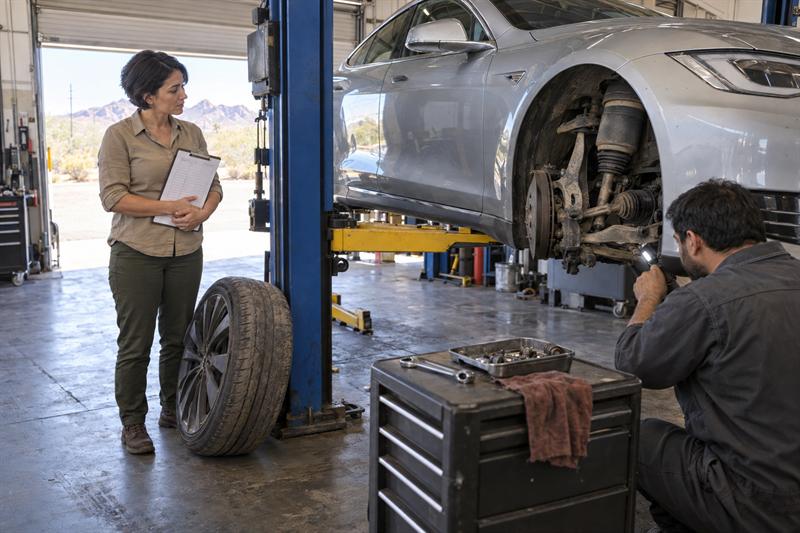
- Lift or ramp inspection. The technician checks ball joint play, control arm bushing condition, lateral link wear, stabilizer end link play, and components that are only visible with the wheel off.
- Diagnostic screen review. The technician reviews the touchscreen, fault codes, suspension data, and ride height information where applicable.
- Alignment relevance check. If the vehicle is pulling, vibrating, or has just had a suspension component changed, alignment data matters. Alignment becomes part of the repair when the wheel path is off.
- Photo and written documentation. The owner should receive photos or video of the worn parts and a written note explaining what is at limit and what is still usable.
- Required versus optional breakdown. The estimate should separate safety-related work, recommended work, and optional work. This gives the owner the clearest way to decide.
The owner should leave the inspection able to answer three questions: What is actually worn? What is required next? What is optional? If the shop cannot answer those questions clearly, the estimate is not ready for a decision.
If the vehicle shows any of these signs, the next step is an inspection.
- The car pulls to one side at speed or under braking.
- The steering wheel vibrates at highway speed.
- A clunk appeared after a curb strike, pothole, or rough road event.
- The suspension warning has appeared on the touchscreen.
- The inner or outer tire wear is noticeably uneven.
These signs can point to a component that has created movement or lost support. An inspection should happen before the issue affects steering feel, brake balance, or tire contact.
Tesla Suspension Repair Cost and Time in Phoenix
Tesla suspension repair cost in Phoenix is driven by the model, the component, adjacent wear, the labor path, and whether alignment is included. A stabilizer end link is a different repair from a control arm. A conventional Model 3 or Model Y front suspension repair is a different path from Model S or Model X air suspension work.
The estimate should break cost into visible pieces:
- Parts listed individually. The owner should know which part is being replaced and whether one side or both sides are included.
- Labor separated from parts. This makes the amount of proposed work easier to compare.
- Required work separated from optional work. Alignment, tires, and lower-priority replacements should not be hidden inside the safety line.
- Photo or written reference. The estimate should point to the actual part or condition being repaired.
- Completion window. Completion time depends on the component, diagnostic path, and part availability, so the owner should receive a stated expectation before dropping off the vehicle.
A written estimate is a reasonable request. The owner should receive a written scope before approving labor. If the shop finds an additional issue, the correct process is to stop, document the finding, and send the updated numbers before work continues.
Phoenix drivers should compare the full scope, not just the bottom line. A lower quote that skips the adjacent component, alignment relevance, or tire wear review can be harder to compare and may lead to additional work.
Independent Tesla Suspension Repair vs. Dealer Service
For many front suspension concerns on a Model 3 or Model Y in Phoenix, an EV-capable independent shop is a practical first stop for a documented inspection and written estimate. The shop can review the vehicle data, inspect the physical components, check alignment relevance, and provide a written breakdown.
The dealer still has a clear role when the issue is tied to an active warranty claim, a complex air suspension electrical fault, or a calibration step the owner wants handled directly through the manufacturer. In that case, the owner should confirm the specific warranty terms and current recall status directly with Tesla before choosing the repair path.
What matters in either path is the diagnostic standard. The shop should use EV-aware procedures, Tesla-compatible diagnostic access, and parts that match the vehicle specification. The owner should be able to ask what part is being replaced, why it is being replaced, and whether the opposite side should be reviewed at the same time.
Independent service can be appropriate for out-of-warranty vehicles, but the exact warranty terms still govern. The owner should confirm the current warranty status, recall status, and any active claim directly with Tesla, because warranty handling depends on the model, age, mileage, and claim history.
How Suspension Repair Connects to Broader Tesla Maintenance
Suspension repair is not an isolated part change. It sits inside the system that controls tire life, steering precision, brake balance, and overall ride stability. A repair that fixes only the noisiest part can leave the vehicle with the same underlying wear path.
Brake overlap. A suspension issue can create a pull that feels worse under braking. A brake issue can create a pull that feels like a suspension fault. A brake inspection belongs in the review when the pull or noise is affected by braking pressure.
Alignment and tire wear. When a control arm, lateral link, or bushing has created enough movement to change the wheel path, alignment becomes part of the repair. A common outcome is a fixed noise but uneven tire wear because the geometry was not corrected.
Air suspension and electrical data. On Model S and Model X vehicles, a suspension warning can be mechanical, electrical, or related to the ride height system. The repair path changes when a compressor, sensor, valve, or air spring is involved.
A full suspension review may identify more than one related issue at the same time. For example, a low-speed creak can lead to a review that identifies a stabilizer end link, an alignment shift, and inner tire wear that is already at a service limit. This is why the full inspection path matters.
Key Takeaways
- Tesla suspension problems often start with a low-speed creak, click, clunk, cold-start noise, pull, vibration, or uneven tire wear.
- A pull, highway vibration, curb-strike clunk, or suspension warning points to an inspection before the vehicle is treated as normal.
- Phoenix heat, dust, and wet/dry road conditions can make rubber components age faster and make suspension symptoms more visible over time.
- Model 3 and Model Y front suspension work often centers on control arms, ball joints, bushings, lateral links, and stabilizer end links.
- Model S and Model X air suspension issues are a separate repair category and should be diagnosed separately from conventional suspension wear.
- A proper inspection includes a physical check, diagnostic review, photo documentation, alignment relevance, and a required-versus-optional breakdown.
- A clear estimate should separate parts, labor, one-side work, both-side work, optional work, and the expected completion window.
- The practical next step is a documented inspection and a written estimate before any part replacement is approved.
How Revive Auto Center Approaches Tesla Suspension Work
At Revive Auto Center, Tesla suspension work is treated as a symptom and condition review, not a parts swap. The review starts with the reported symptom, confirms the physical condition, and checks related parts that share the same load path.
The focus stays on the owner, the vehicle condition, and the work supported by the inspection. That keeps the estimate easier to understand and easier to justify.
A clear review should help the owner see the worn component, understand why it is being recommended, and identify which items are required and which are optional. When a control arm, bushing, lateral link, or stabilizer end link is involved, the review also looks at the adjacent side, tire wear pattern, and alignment relevance.
This matters because a suspension repair can expand when the first repair only addresses the loudest symptom. The goal is to correct the issue, document the reason, and give the owner a clear path to approve what is needed without paying for unsupported work.
Frequently Asked Questions
Is it safe to drive a Tesla with a suspension creak or click?
A low-speed creak or click by itself is not usually an immediate stop-driving event, but it is a wear signal. If the noise comes with a pull, clunk, vibration, or warning, the vehicle should be inspected before normal use continues.
How much does Tesla suspension repair cost in Phoenix?
The cost depends on the Tesla model, specific component, whether the repair covers one side or both sides, whether alignment is included, and whether the issue involves air suspension. A blended number is harder to evaluate. The estimate should list parts, labor, optional items, and the condition being repaired.
Will independent Tesla suspension repair void the warranty?
Independent service is a common option, but warranty treatment depends on the current terms, model, mileage, and any active claim. The owner should confirm warranty status, recall status, and any active claim directly with Tesla. The repair shop can document the work, but the warranty relationship is between the owner and the manufacturer.
How long does a Tesla suspension repair take?
Completion time depends on the component, diagnostic path, and part availability. Air suspension work on Model S and Model X can take longer depending on the part and the data found during diagnosis. The owner should receive a stated completion expectation before dropping off the vehicle.
Do I need a Tesla specific shop for suspension repair?
A shop does not need to be Tesla-only to inspect a suspension issue, but it needs EV-aware procedures, Tesla-compatible screen and fault review, and experience with the load and geometry of the vehicle. If the issue involves air suspension, a suspension warning, or an electrical fault, EV-specific diagnostic capability becomes more important.
Should I replace the opposite side if one suspension part is failing?
Replacing both sides is common when the opposite side is near the end of its service life. Paired components wear under similar loads, but one side can wear faster than the other. The correct decision depends on the physical condition of the opposite component. Ask for a photo or written note on the opposite side before deciding.
Conclusion
A Tesla suspension problem in Phoenix is usually not a mystery, but it is not a minor detail when it changes steering, ride height, or tire wear. A repeated creak, click, or clunk often signals a component that has started to lose support. If it is ignored, the issue can grow into a larger repair involving steering feel, tire wear, or adjacent parts.
When the vehicle is pulling, vibrating, sitting unevenly, or showing a suspension warning, the correct next step is a documented inspection, a written estimate, and a clear breakdown of required versus optional work before any part is charged.
Revive Auto Center is a practical next step for Phoenix drivers who want Tesla suspension repair built around clear evidence and a fair process. The estimate should show the physical component, vehicle data, tire condition, alignment relevance, and adjacent parts before the final work is approved. That gives the owner a clear understanding of what is being replaced and why.
If the car has a new suspension noise, a change in steering feel, or uneven tire wear, request a free quote through Revive Auto Center and get the concern evaluated before it becomes a larger repair.