
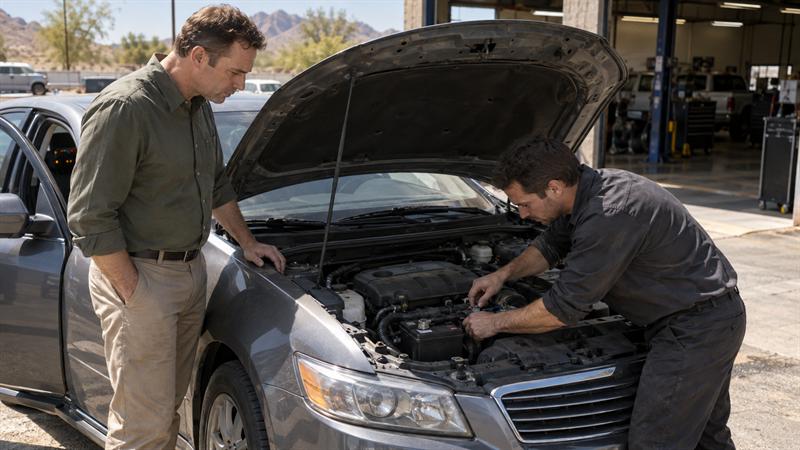
Why Car Electrical Problems Can Be Hard to Identify
Electrical issues can be hard to pin down because one weak point can affect several systems at once. A battery problem, a poor ground, low charging output, or a damaged connection can all create symptoms that seem unrelated at first.
This is where many drivers get stuck. The car may crank slowly one day, show flickering lights the next, and then act normal for a while. That pattern is often tied to unstable voltage rather than one obvious failed part.
At Revive Auto Center, intermittent no-start complaints and repeat battery failures often follow that pattern. The first symptom is rarely the full story. When parts are replaced before the power supply and connections are checked, the original problem can stay in the vehicle and keep causing trouble.
That is also why broader auto repair diagnostics matter here. Electrical symptoms do not always stay contained to one system.
Common Signs You May Need Car Electrical Diagnostics
Most drivers do not look into electrical diagnostics until the symptoms start affecting daily use. By that point, the vehicle is often already showing a pattern.
- Slow cranking or clicking when starting
- The battery repeatedly going dead
- Dim or flickering headlights and dash lights
- A battery warning light or charging warning on the dash
- Power windows, locks, mirrors, or accessories working inconsistently
- Several warning lights appearing together
- Sensors or electronics acting erratically
If several of these signs show up together, the issue may be bigger than a simple dead battery. A weak connection or charging problem can create enough voltage instability to affect multiple systems at the same time.
The First Checks in a 12V Battery and Electrical Diagnosis
Battery condition, charge level, and terminal inspection
The 12V battery is usually the first thing to check because weak battery performance can affect starting, lighting, sensors, and module behavior. That does not mean the battery is always the root cause, but it is often where the diagnostic process begins.
Battery state of charge and battery condition are not the same thing. A battery can show voltage and still perform poorly under load. That is often tied to slow cranking, inconsistent starts, or electronics that act unstable even though the battery does not look completely dead.
Terminal condition matters too. Corrosion, loose connections, and damaged cable ends create resistance, and resistance can lead to voltage loss where the vehicle needs current most. If the terminals are not clean and secure, replacing the battery alone may not solve the problem.
When repeated dead battery issues show up, battery testing and service is often a practical checkpoint.
Charging system and alternator output
A weak charging system can look a lot like a bad battery. The car may start after a jump or a recent replacement, then fall back into the same pattern because the battery is not being replenished properly.
This often becomes more noticeable while driving. Warning lights may come on, lights may dim, accessories may behave unpredictably, or the vehicle may start fine one day and struggle the next. A common pattern is a car that seems fixed after a battery replacement, then returns with the same complaint because the charging side was never confirmed.
That is where deeper electrical repair testing matters. If charging output is weak or inconsistent, the battery may take the blame for a problem it did not create.
Starter performance and voltage drop testing
There is a difference between a no-crank, a slow-crank, and a normal-crank but no-start condition. Those differences help narrow the direction of the diagnosis.
A slow-crank often points back to battery performance, cable resistance, or starter draw. A no-crank with clicking can point to a weak battery, a bad connection, or a starter circuit issue. A normal-crank but no-start often pushes the diagnosis beyond basic starting power and into other systems. This is where voltage drop testing becomes useful because it can show where power is being lost under load instead of assuming the starter itself is the problem.
Grounds, fuses, relays, and visible wiring issues
Bad grounds are a common cause of confusing electrical behavior. One poor ground can affect several components and create symptoms that look bigger and more expensive than they really are.
At Revive Auto Center, this can show up when vehicles come in with multiple odd issues at the same time. Flickering lights, inconsistent accessory function, and grouped warning lights may trace back to connection quality, not just failed modules.
Visible wiring damage, heat-stressed connectors, fuse issues, and relay faults all belong in the early stages of diagnosis. If these checks are skipped, the repair path can turn into parts replacement without a clear answer. That is why connection and circuit checks are a core part of electrical system diagnosis.
If the same symptoms keep coming back, the vehicle usually needs more than a jump-start or another battery.
- It starts after a jump, then struggles again within days
- Several warning lights appear together
- Lights or accessories dim while driving
- The battery has already been replaced, but the problem returned
That pattern usually means the underlying fault has not been isolated yet.
Battery, Alternator, or Something Else? How Symptoms Often Differ
Patterns that often point to a battery issue
Battery-related symptoms usually show up during startup. Slow cranking after the car sits, weak accessory power before startup, or a vehicle that starts with a jump and then struggles again later all point in that direction.
This often means the battery is no longer delivering power well under load, even if it still shows some voltage. What gets misunderstood is that a battery problem can create broader electrical behavior, which makes it easy to blame other systems too soon.
If those symptoms keep repeating, a focused check through battery services is often the most practical place to start.
Patterns that often point to a charging system problem
Charging problems usually show themselves after the vehicle is already running. The battery warning light may come on, electronics may become unstable, or the battery may repeatedly go low even after replacement.
This can create a cycle where the battery appears to be the problem because it keeps ending up discharged. In reality, the charging system may be failing to maintain the battery during normal use. If the vehicle starts normally after charging but falls back into the same condition, that often points away from the battery and toward charging output or related electrical faults.
When wiring, connectors, or modules may be involved
When several unrelated systems fail together, the issue often moves beyond the battery and alternator. This includes grouped warning lights, accessories dropping out together, intermittent communication problems, or electronics that behave differently from one drive to the next.
This is where problems can get mishandled. Parts are replaced based on the loudest symptom, while the actual fault may remain in a connector, harness, ground path, or circuit. If the issue changes with heat, vibration, or time, deeper wiring and system testing is often required.
Drivers dealing with modern electrical faults may also benefit from understanding the same general diagnostic logic covered in Tesla diagnostic checks in Phoenix. The platform is different, but the process still starts with the right testing.
Why Phoenix Conditions Matter for Battery and Electrical Problems
Heat stress on 12V batteries
Phoenix heat is hard on 12V batteries. High temperatures can reduce battery reliability over time, and the early signs often show up as inconsistent starts, slower cranking, or batteries that seem fine until the next hot stretch or parked period.
At Revive Auto Center, this is a familiar pattern in vehicles that sit outside for long periods or make short trips that do not fully recover the battery. The battery does not always fail all at once. It often weakens first, and that weakening may start showing up through starting complaints and unstable electrical behavior.
Connectors, insulation, and under-hood wear
Heat does not only affect the battery. It also puts stress on connector bodies, wiring insulation, and under-hood electrical connections over time.
This is where small issues can turn into bigger ones. A connector that loosens or degrades from heat creates resistance, and resistance can lead to unstable circuit performance. That is often associated with intermittent problems that are easy to dismiss at first and harder to diagnose later.
Heat-related wear shows up across vehicle systems in Phoenix, which is one reason local protection and maintenance choices matter. The same environment that affects wiring and connectors also shapes decisions around Phoenix sun and heat protection more broadly.
A/C demand and electrical load
Heavy A/C use increases electrical demand, especially when blower motors, cooling fans, and other accessories are all working hard at the same time. That extra load can expose weak charging performance and weak battery performance faster.
A common pattern is a vehicle that seems manageable in lighter use, then starts showing dimming, unstable electronics, or harder starts when cooling demand stays high. If the A/C system is part of that pattern, related air conditioning repair checks may also matter because electrical load and cooling performance can overlap in real-world symptoms.
What a Professional Car Electrical Diagnostic Visit May Include
Testing before replacing parts
Good electrical diagnosis starts with testing, not with choosing the most likely part. Replacing a battery, alternator, or starter before confirming the fault can lead to repeat visits and the same unresolved complaint.
At Revive Auto Center, the practical goal is to narrow the issue in the right order. That means confirming the power supply, connection quality, and charging behavior before moving deeper into circuits or component replacement.
Scanning modules and checking stored faults
Modern vehicles store useful clues beyond the engine system alone. Electrical faults may affect multiple modules, and those stored faults can help show whether the vehicle is dealing with voltage instability, communication problems, or a circuit issue tied to a specific area.
This matters because many electrical complaints feel random from the driver seat. Once the vehicle is tested as a system, the pattern often becomes clearer and the repair path can become more efficient.
Tracking intermittent drains and hard-to-repeat issues
When the battery keeps dying while the car is parked, parasitic draw testing becomes important. That process helps identify whether something is staying active when it should shut down.
Intermittent issues are harder because the fault is not always present during a quick inspection. If the car only acts up after sitting, after heating up, or under certain loads, the diagnosis needs to follow that pattern instead of assuming the last failed start tells the whole story.
When to Schedule Electrical Repair or Battery Service
Once electrical symptoms become repeat issues, waiting often leads to more downtime and more confusion. The problem does not always stay contained to one inconvenience.
- Repeated jump-starts
- No-starts or near no-starts becoming more frequent
- Battery warning lights or charging concerns while driving
- Multiple electrical symptoms showing up together
- A battery replacement that did not fix the complaint
If you are seeing that pattern, a simple battery check is often not enough anymore. The next step is a full evaluation of the battery, charging system, starting circuit, grounds, and related electrical connections.
Key Takeaways
- Electrical symptoms overlap, so the loudest symptom is not always the real cause.
- The 12V battery is usually the first checkpoint, but not the only one.
- Phoenix heat can speed up battery wear and add stress to connectors and wiring.
- Charging, starting, and wiring faults often mimic each other until the vehicle is tested properly.
- Repeat jump-starts and repeat battery failures often mean the original problem is still in the car.
Conclusion
The real problem with car electrical issues is not just that the vehicle will not start or that the battery keeps going dead. It is that unstable power can spread across the system, create misleading symptoms, and lead to the wrong repair when testing is skipped.
If this is not addressed properly, the pattern often gets worse. A weak battery can become a repeat no-start. A charging issue can keep draining new batteries. A bad ground or failing connection can keep triggering new electrical complaints until the vehicle becomes increasingly unreliable.
Revive Auto Center is a practical next step when the symptoms keep returning, when several electrical issues are showing up together, or when a battery replacement did not solve the problem. The patterns discussed here are why proper electrical testing matters. Start with electrical repair or battery services so the issue can be identified in the right order instead of guessed at one part at a time.
Company Approach
At Revive Auto Center, electrical diagnosis should follow the pattern the vehicle is actually showing. That means looking at the battery, charging behavior, connections, grounds, and symptom timing before jumping to replacement decisions.
This approach matters because many electrical complaints are not single-part failures. They are often system problems that start with unstable voltage, heat-stressed connections, or recurring drains. When the testing follows that logic, the repair path often becomes clearer and the repeat-failure cycle can stop.
FAQ
How do I know if my car has a battery problem or a bigger electrical issue?
A battery problem is more likely when the vehicle cranks slowly, needs a jump after sitting, or shows weak accessory power before startup. A bigger electrical issue is more likely when the battery keeps going dead after replacement, multiple systems act up at once, or warning lights and accessory failures show up together.
The key distinction is that a weak 12V battery can create broad electrical symptoms without being the only fault. Some voltage on the battery does not prove the battery is performing properly under load.
What does a car electrical diagnostic usually include?
A car electrical diagnostic usually starts with battery condition and charge testing, then moves into charging system checks, starter operation, terminals, grounds, fuses, relays, and visible wiring. If needed, it may also include module scanning and parasitic draw testing when the battery dies while parked.
The important point is that diagnosis is a sequence. The goal is to separate power supply problems, charging faults, starting circuit issues, and communication-related symptoms instead of replacing parts based on the first sign that stands out.
Why does my battery keep dying even after it was replaced?
A battery often keeps dying after replacement because the actual problem is somewhere else. Common causes include weak charging output, poor terminal contact, corrosion, a bad ground, or an electrical drain while the vehicle is parked.
If a new battery restored function only briefly, the replacement did not solve the root cause. It only reset the symptom for a short time.
Can Phoenix heat affect my car battery and electrical system?
Yes. Phoenix heat puts extra stress on 12V batteries and can also affect connectors, wiring insulation, and under-hood electrical parts over time.
Heat-related electrical problems do not always show up as an immediate failure. They often begin as inconsistent starts, intermittent warning lights, or electrical behavior that becomes more obvious under heavier load.
What causes intermittent no-start or random electrical problems?
Intermittent no-start and random electrical behavior usually come from faults that do not fail continuously. Weak battery performance, unstable grounds, poor terminal contact, heat-affected connectors, wiring problems, and inconsistent charging are common examples.
That is why these issues are frustrating to diagnose from symptoms alone. If the pattern changes with heat, vibration, parked time, or accessory load, the vehicle is often showing that the fault is condition-based rather than permanently failed.
When should I schedule professional battery or electrical testing instead of just getting a jump-start?
Professional testing is the better move once jump-starts are repeated, slow-crank or no-start events are becoming more frequent, the battery warning light appears, or several electrical symptoms start happening together.
A jump-start only restores power long enough to use the vehicle again. It does not explain why the battery was low, why the voltage dropped, or why the same issue is repeating. Once the pattern repeats, the real need is diagnosis, not another temporary restart.