
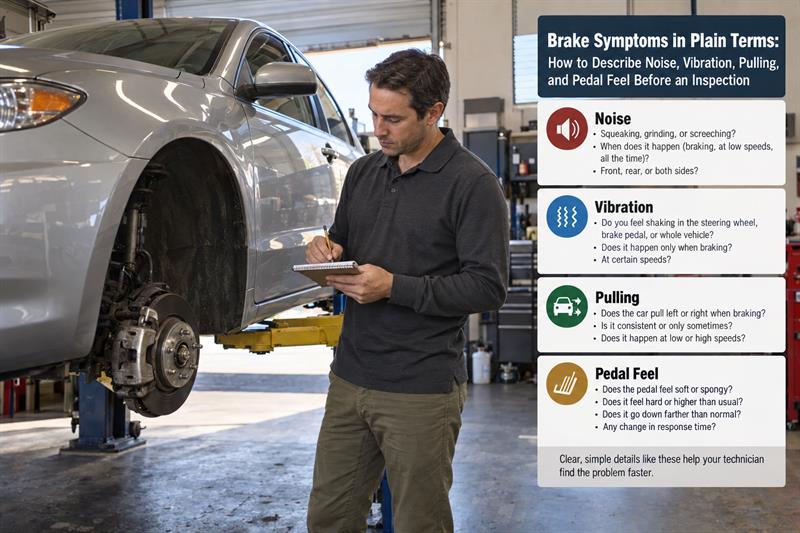
Something changes in the way the car slows, and the first question is usually whether it can wait until the weekend. The second question is harder: how do you explain a sound you have only heard from the driver’s seat? Brakes rarely announce one tidy problem. A high tone, a shimmy in the wheel, a drift toward the curb at a stoplight — each one has several possible origins, and the words chosen at the counter are what let a technician start in the right spot instead of the nearest convenient one.
Why the Description Matters as Much as the Symptom
Two different jobs are happening when you walk into a shop. One belongs to the driver: reporting the conditions under which the car misbehaves. The other belongs to the technician: measuring parts against a specification. A micrometer cannot tell anyone whether the noise happens on the first stop of the morning or only after a long descent off a mountain grade.
That gap is why the same complaint can send two cars in different directions. Identical squeals from two vehicles can trace to different parts, because the sound is produced by different surfaces meeting in different ways. The description does not need to be technical. It needs to be specific enough that the technician can try to reproduce what you felt.
Noise: Separating Squeal, Squeak, Grind, and Scrape
Disc brakes slow a car by squeezing pads against a rotor. Some rear axles still use drum brakes, where shoes press outward against a drum, and those make their own family of sounds. Knowing which system sits on the axle in question is one reason the year, make, and model matter before anyone interprets a noise.
The word brake squeal covers a high, steady tone, and it can come from more than one source. A thin metal wear indicator touching the rotor is a common one, since it is built to make noise before the pad material is gone. Pad vibration, glazing, and built-up dust can produce a similar tone. A squeal that shifts or quiets when you press the pedal lightly is a useful detail, because it points to a vibration responding to pressure rather than to a part that is simply worn.
A grind or scrape is a different report. When it continues while the car is rolling, or appears only with the pedal down, the usual concern is metal-to-metal contact, and that moves the conversation toward urgency rather than scheduling. A single click or clunk when the pedal first moves, or when the car changes direction, is smaller in volume and often comes from a pad shifting in its caliper bracket or from worn hardware. Volume is not a measure of severity, which is why the type of sound tells a technician more than how loud it is.
Vibration: Pedal, Steering Wheel, or Whole Vehicle
Where the shake arrives is as useful as the shake itself. Pulsation through the pedal is associated with variation in the rotor surface or thickness, or with uneven deposits of pad material transferred onto it. A judder that builds as you slow from freeway speed and fades the moment the pedal is released is a pattern a technician can attempt to repeat on a road test.
A shake in the steering wheel points toward the front of the car. A shake felt through the seat and the floor points toward the rear. Those two descriptions send an inspection to different corners of the vehicle, and both are far easier to give than a general report that the car vibrates.
Pulling: Which Way, and When It Begins
When a car pulls when braking, direction and timing carry the most weight. Which way does the wheel turn? Does it happen on every stop or only the firm ones? Does the car track straight until the pedal moves, or was it already drifting before you touched it?
A pull under braking can come from a caliper that does not release evenly, a collapsed or restricted hose, or friction material that is uneven from side to side. A pull that is already there while driving, and unchanged by the pedal, points away from the brakes, toward tires, wheel alignment, or something in the suspension. That distinction is the difference between one appointment and another, so it is worth observing carefully rather than assuming.
Pedal Feel: Firm, Soft, Long, or Low
Soft and long get used interchangeably, but they describe different things. A soft or spongy pedal is associated with air or moisture in the hydraulic system, or with a hose that expands under pressure instead of moving fluid. A pedal with a long travel that still stops the car is a different report from one that feels mushy from the top of its stroke.
A pedal that sinks slowly while you hold it at a stop can indicate a leak or an internal bypass in the master cylinder. A pedal that feels hard and demands extra effort is associated with the vacuum or hydraulic assist rather than with pad wear. None of those observations identifies a failed part on its own, but each one narrows the set of checks worth doing first.
The Details That Turn a Complaint Into a Record
A short note on a phone beats a memory rebuilt at the service desk a week later. The pattern matters more than the volume: a noise that only shows up once the brakes have warmed through tells a different story than one that greets you at the first stop of the morning.
Write down what can be observed without guessing at causes. The cause is the technician’s job. The conditions are yours, and they are the part of the record that cannot be recovered later.
- When the symptom first appeared, and whether anything changed around then: new tires, a rotation, a road trip, a repair.
- Whether the symptom shows up cold, once the brakes have warmed, or at both times.
- The speed range where it shows up, and whether light or firm pedal pressure changes it.
- Weather and whether the car sat overnight, since the first few stops after a humid night can sound different.
- The direction of a pull, and the moment it starts relative to the pedal.
- Load: passengers, a full trunk, a trailer, and any recent tire, wheel, or brake work.
What the Inspection Does With That Description
A brake inspection is the measuring step that follows the description. Pad thickness gets checked at each wheel, not only the outer pad visible through the spokes. Rotor thickness and surface condition are measured, caliper movement and hose condition are checked, and the fluid is evaluated. Where the complaint calls for it, a road test is used to try to reproduce the symptom under the conditions you described.
This is also where the notes pay off. A technician who knows the noise appears only on firm stops once the brakes have warmed will drive differently than one who was told only that the car squeaks. Brake services at Revive Auto Center cover pad replacement, rotor service, brake fluid service, and repair of calipers and related parts, alongside general auto repair and tire work when the symptom turns out to sit outside the brake system. Estimates and consultations are free, so the discussion about what the measurements show can happen before anything is authorized.
Electric vehicles add a wrinkle. On a Tesla or another EV, regenerative braking handles much of the normal slowing, so the friction brakes can be used lightly for long stretches and a symptom can take longer to show itself. The description starts the process the same way; what a brake inspection covers on a Tesla simply accounts for that lighter use.
Symptoms That Should Not Wait for a Scheduled Visit
Some reports are not about scheduling. A pedal that goes to the floor, a hard pull to one side under braking, a grind that appears suddenly, fluid on a wheel or under the car, or a brake warning lamp are reasons to stop driving and arrange help. Those signs can point to a loss of hydraulic pressure or to metal contact, and neither improves with another week of commuting.
If a symptom began after an impact, from a curb, a pothole, or a parking lot hit, it is worth looking at the car as a whole rather than only the corner that took the blow. A vehicle inspection checklist after a minor collision covers the panels, lights, tires, and alignment that can share a cause with a brake complaint.
When the Tires Are the Thing That Feels Wrong
Tires and wheels can imitate brake symptoms closely. Uneven wear, a separated belt, a bent wheel, or a wheel that is out of balance can produce a shake or a drift that feels like it belongs to the brakes. The separating question is timing: a vibration that only appears under braking leans toward the brake system, while one that is present at a steady cruise and unchanged by the pedal leans toward the wheel end.
That is why tire rotation, balance, alignment, and wear inspection often runs alongside a brake check. Two sets of measurements in one visit tend to give a clearer answer than either one alone.
Key Takeaways
- Describe the type of sound, squeal, grind, or click, rather than only its volume.
- Say where a vibration is felt: pedal, steering wheel, or seat and floor.
- Note the direction of a pull and whether it starts before or with the pedal.
- Use plain words for pedal feel: soft, long, sinking, or hard.
- Record when the symptom appears, at what speed, and under what conditions.
Conclusion
None of this requires mechanical vocabulary. It requires attention to a few details that are easy to notice and easy to forget by the time the car is on a lift: the sound, the location of the vibration, the direction of the pull, the feel of the pedal, and the conditions that bring each one out. Revive Auto Center has worked on Phoenix vehicles for more than 25 years, and a written description is one of the most useful things a driver can carry through the door. When you are ready to have it looked at, request a free estimate and put those notes in front of the person doing the measuring.