A dent does not automatically require repainting, but it does not automatically qualify for PDR either. At Revive Auto Center, the repair decision involves more than the dent’s size. Paint condition, panel shape, metal movement, access, and surrounding damage all matter.
Choosing a repair method based on the visible dent alone can leave part of the damage unaddressed. A dent with damaged paint may still need refinishing, while an impact near a bumper, light, trim piece, or panel seam can require a broader look than cosmetic dent repair alone.
The Quick Difference Between Paintless Dent Repair and Traditional Body Repair
Paintless dent repair and traditional body repair address different types of damage. PDR focuses on restoring suitable dents while preserving the existing finish. Traditional repair addresses damage involving paint loss, sharp distortion, stretched metal, or a wider affected area.
What Paintless Dent Repair Does
Paintless dent repair, commonly called PDR, reshapes a damaged panel without conventional filler and repainting when the damage is suitable. The goal is to restore the panel while keeping the original finish in place.
PDR is not simply a small-dent service. A shallow dent in an accessible area with intact paint is generally a stronger candidate than a smaller dent on a sharp body line or near a panel edge. Learn more about paintless dent repair services when the paint appears undamaged.
What Traditional Body Repair May Involve
Traditional body repair may include reshaping the panel, using repair materials where appropriate, preparing the surface, refinishing the damaged area, and matching the repaired section to the surrounding paint. This process is often used when the damage goes beyond what PDR alone can correct.
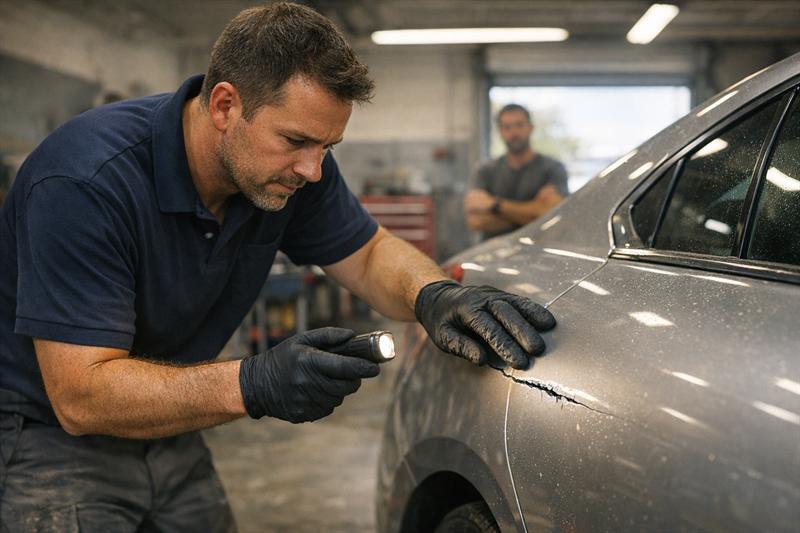
A chipped finish or sharp crease changes the repair decision. Reshaping metal does not repair broken paint, so finish damage generally needs to be addressed as part of the repair scope.
Quick Comparison: PDR vs. Traditional Body Repair
- Paint condition: PDR is generally considered when paint remains intact. Traditional repair is often considered when paint is cracked, chipped, or deeply scratched.
- Metal condition: Smooth, accessible damage is generally more favorable for PDR. Sharp creases and stretched metal can require conventional repair.
- Refinishing: PDR may avoid repainting when appropriate. Traditional repair may include refinishing and paint matching.
- Damage scope: Broader impact damage can require a collision repair evaluation rather than a dent-only decision.
This is a practical comparison, not a determination that can always be made from photos. Two dents that look similar in an image can require different repair processes once the paint, panel shape, and access points are examined.
Paintless Dent Repair vs. Body Repair: What Actually Determines the Right Option?
The right repair method depends on the condition of the panel, not a simple size measurement. A small dent can have cracked paint, a sharp impact point, or limited access behind the panel, all of which can change the recommended process.
Is the Paint Intact?
Paint condition is one of the clearest differences between PDR and traditional body repair. If the paint is cracked, chipped, missing, or deeply scratched, the panel may need more than dent reshaping because the finish itself has been damaged.
Preserving factory paint can be valuable when the finish is still in good condition. But leaving damaged paint in place does not resolve the finish damage. This is why a dent with a paint chip often leads to bodywork and refinishing rather than PDR alone.
How Deep, Sharp, or Stretched Is the Dent?
A broad, shallow dent and a narrow, sharp crease do not behave the same way. A shallow impression can sometimes be reshaped, while a sharp impact point changes the panel contour more abruptly and can stretch the metal.
Door creases and dents on pronounced body lines show this difference clearly. The smaller dent is not always the easier repair. Once metal is sharply folded or stretched, traditional body repair is often the more practical path.
Where Is the Dent Located?
Dents near a wheel opening, door seam, panel edge, reinforced section, or body line are generally more complex than dents in a broad, flat panel area. The vehicle’s shape becomes part of the repair decision in these locations.
A dent near an edge or crease requires attention beyond the center of the mark. The repair should account for the panel’s original contour and how the damaged area connects to the rest of the panel.
Can the Repair Area Be Accessed?
PDR depends on access to the damaged area or an appropriate exterior repair method. Inner braces, reinforcements, component placement, and panel construction can limit how the metal can be reached and reshaped.
This is why the same type of dent can be more straightforward on one vehicle than another. If access is limited, a paintless repair approach may not be the best fit, and a different repair process may be needed.
Is There Damage Beyond the Visible Dent?
A dent after an impact can involve more than the outer panel. Bumper cracks, loose trim, damaged lights, panel misalignment, or damage near vehicle components can shift the repair from cosmetic dent removal to collision repair.
When a dent follows an impact rather than a simple door ding, collision repair is often the more appropriate starting point.
When Paintless Dent Repair May Be Appropriate
PDR is generally most practical when the finish is intact, the metal has not been heavily stretched, and the dent is in an area that can be accessed and reshaped accurately.
- Shallow dents with paint that appears intact.
- Some door dings from shopping carts or adjacent vehicle doors.
- Some hail dents, depending on their depth, location, and paint condition.
- Smooth dents away from difficult panel edges and sharp body lines.
- Damage where the panel can be accessed and the metal has not been significantly stretched.
These examples are starting points, not guarantees. A smooth door ding in the center of a panel is generally more suitable for PDR than a shallow dent near a reinforced edge. Location, paint condition, and access affect the repair path.
When Traditional Body Repair and Paint Work May Be the Better Option
Traditional body repair is often the better option when the panel needs more than metal reshaping. It can address distorted metal, damaged paint, and impact-related concerns around the affected area.
The Paint Is Cracked, Chipped, or Deeply Scratched
When paint is broken, the repair generally needs to address the finish as well as the dent. A chip at the center of an impact, cracked clear coat, or deep scrape changes the scope because moving the metal alone does not restore the damaged finish.
This often leads to surface preparation and refinishing. If the finish damage is left untreated, the panel may still show visible damage even when the dent shape improves.
The Dent Has a Sharp Crease or Significant Metal Stretch
Sharp creases, deep impact points, and distorted panel contours often need traditional body repair. These dents force the metal into a more abrupt shape than a smooth, shallow impression.
A common misunderstanding is that a small crease should be easy because it covers less area. In practice, the sharpness of the crease and the way it crosses a body line can make it more involved than a larger dent.
The Damage Is Near a Panel Edge or Complex Body Line
Panel edges, wheel arches, curves, and strong body lines are areas where a dent can be harder to restore cleanly. These sections have less flexibility, and the original panel shape must be considered carefully during repair.
Treating this damage like a simple door ding can lead to an incomplete repair plan. The dent’s location is a reason to examine the panel more closely.
The Damage Came From a Collision or Involves Nearby Components
Damage from a collision should be considered across the affected area, especially when there are bumper cracks, misaligned panels, broken trim, damaged lights, or nearby component concerns. The visible dent can be the first sign that more of the vehicle needs attention.
For a closer look at how these repair paths differ, see auto body restoration vs. collision repair. The key distinction is whether the issue is isolated to the panel and finish or tied to a broader impact.
Common Dent Scenarios: Which Repair Method Might Be Considered?
Common dent types provide a useful starting point, but the condition of the specific vehicle still determines the repair choice. These examples show what typically changes the decision.
Shallow Door Ding With Intact Paint
A shallow door ding with intact paint is frequently a PDR candidate when it sits in an accessible part of the panel. If the dent is close to a body line, panel edge, or reinforcement, the repair becomes more complex and needs closer evaluation.
Hail Dent
Some hail dents are well suited to PDR because they are often shallow and leave the paint intact. The number of dents, panel location, paint condition, and access behind each panel determine the repair scope.
Sharp Crease Across a Door or Fender
A sharp crease across a door or fender often points toward traditional body repair when the metal is stretched or the crease runs through a body line. The issue is not just depth; it is the abrupt change in the panel’s original shape.
Dent With Scraped or Missing Paint
A dent with scraped or missing paint often needs traditional repair and refinishing because both the metal and finish have been affected. Paint matching becomes part of the process when the repaired section needs to blend with the surrounding panel.
Bumper or Panel Damage After an Impact
Bumper or panel damage after an impact calls for a wider review when there are cracks, misalignment, loose trim, damaged lights, or adjoining panel damage. The visible dent may not represent the full repair scope.
What Affects the Scope of a Dent Repair Estimate?
A dent repair estimate should reflect the condition of the vehicle, not a generic price chart. The method, labor, refinishing needs, and total scope change with the damage itself.
- The number of dents and affected panels.
- The dent’s depth, sharpness, and location.
- Whether the metal is stretched or sharply creased.
- The condition of the paint and clear coat.
- Panel material, shape, reinforcement, and access.
- Whether refinishing and paint matching are needed.
- Whether the impact affected nearby components or requires broader collision repair.
This is where price assumptions can go wrong. PDR avoids refinishing when the panel is suitable, but a complex crease or limited access can still require detailed work. Traditional repair is often necessary when paint and panel damage need to be corrected together.
Why an In-Person Damage Assessment Matters
If your dent includes cracked paint, a sharp crease, a bumper impact, loose trim, or panel misalignment, an in-person evaluation can help determine the appropriate repair scope.
- The paint is chipped, cracked, scratched through, or missing at the dent.
- The dent crosses a body line, sits near an edge, or has a sharp center point.
- The damage followed an impact rather than a simple parking-lot ding.
- Nearby trim, lights, bumpers, or panels no longer sit correctly.
Photos are useful for starting the conversation, but they do not always show paint condition, metal stretch, panel access, or related damage. When these signs are present, an in-person evaluation helps determine whether PDR, traditional body repair, paint work, or a combination of services is appropriate.
Key Takeaways
- Paintless dent repair may be an option when paint remains intact and the dent’s location, shape, and access support the process.
- Traditional body repair is often appropriate for cracked paint, sharp creases, stretched metal, and broader impact damage.
- Dent size is only one part of the repair decision.
- A small dent on a body line or panel edge can require more work than a larger, smooth dent.
- An estimate should reflect the actual panel condition and any surrounding damage, not a one-size-fits-all repair assumption.
Choosing the Right Repair Path With Revive Auto Center
Revive Auto Center evaluates dent damage by looking at what the impact changed. That includes the finish, panel contour, dent location, access behind the panel, and signs that the impact affected more than the visible surface.
This approach helps avoid two common mistakes: treating every dent as a PDR job or assuming every dent requires a full repaint. The repair should follow the vehicle’s condition, with a clear explanation of what needs attention and why.
Conclusion
The real issue is not choosing between paintless dent repair and body repair based on dent size alone. The decision depends on whether the paint is intact, whether the metal is sharply creased or stretched, where the damage sits on the panel, and whether the impact affected nearby areas.
When those details are overlooked, paint damage can remain unresolved, difficult creases can be treated like simple dings, and collision-related damage may receive insufficient attention. Revive Auto Center can evaluate the damage and recommend a repair path that fits the vehicle, whether that means PDR, bodywork, paint services, or collision repair.
Request a free repair estimate when the dent includes paint damage, a sharp crease, an impact area, or uncertainty about what the panel needs next.
Frequently Asked Questions
Is paintless dent repair better than traditional body repair?
Neither method is automatically better because each solves a different damage problem. PDR is generally a strong option when the paint remains intact and the panel can be reshaped without refinishing. Traditional body repair is often the right choice when paint is cracked or missing, metal is sharply creased or stretched, or an impact affects more than the panel surface.
A broad, smooth dent can be a better PDR candidate than a smaller dent on a sharp body line. The important distinction is how the panel and finish were affected, not just how large the dent looks.
Can paintless dent repair fix a dent with chipped or scratched paint?
PDR can address the metal shape in some situations, but it does not correct chipped, cracked, or deeply scratched paint. When the finish is damaged at the impact point, paint repair and refinishing may become part of the required work.
A panel can look smoother after dent work while still showing a damaged finish. That is why a dent with a paint chip often needs more than paintless dent repair alone.
Does a small dent always qualify for paintless dent repair?
No. A small dent does not automatically qualify for PDR if it has a sharp impact point, sits on a body line, is close to a panel edge, or has limited access behind the panel. Metal stretching also changes the repair decision.
A larger, shallow dent with intact paint in an accessible section of the panel is frequently a better PDR candidate than a smaller but sharply creased dent. Size matters less than the way the metal moved and where the damage sits.
Can a crease in a car door be repaired without repainting?
Some door creases can be repaired without repainting when the paint remains intact and the metal has not been significantly stretched. A sharp crease that crosses a body line or sits near a door edge can require traditional body repair and refinishing.
A soft, shallow impression is different from a narrow, sharply folded line in the metal. That difference helps determine whether preserving the original paint is realistic or whether the panel needs a broader repair process.
What affects the cost of paintless dent repair versus body repair?
The repair scope depends on the number of dents, affected panels, dent depth, location, panel access, paint condition, metal stretching, and whether refinishing is needed. Damage from an impact can also add bumper, trim, light, or nearby panel concerns to the repair.
PDR has a different scope because it can avoid refinishing when the panel and paint are suitable. But PDR is not automatically the lower-cost option. A complex crease, difficult access point, or several affected panels can increase the work involved.
Should a dent from a collision be inspected even if the paint looks okay?
Yes. When a dent followed a collision, the affected area should be considered beyond the paint condition. Intact paint does not show whether the panel, bumper, trim, lights, mounting points, or nearby components were affected.
This does not mean every dent has additional damage. It means the cause and location matter. A simple door ding and a dent following a bumper impact can require different levels of evaluation.